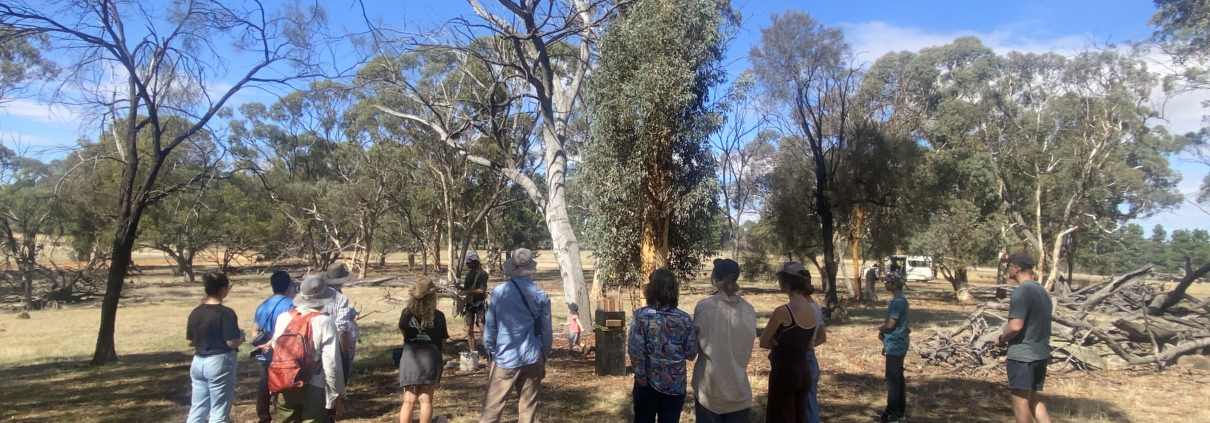
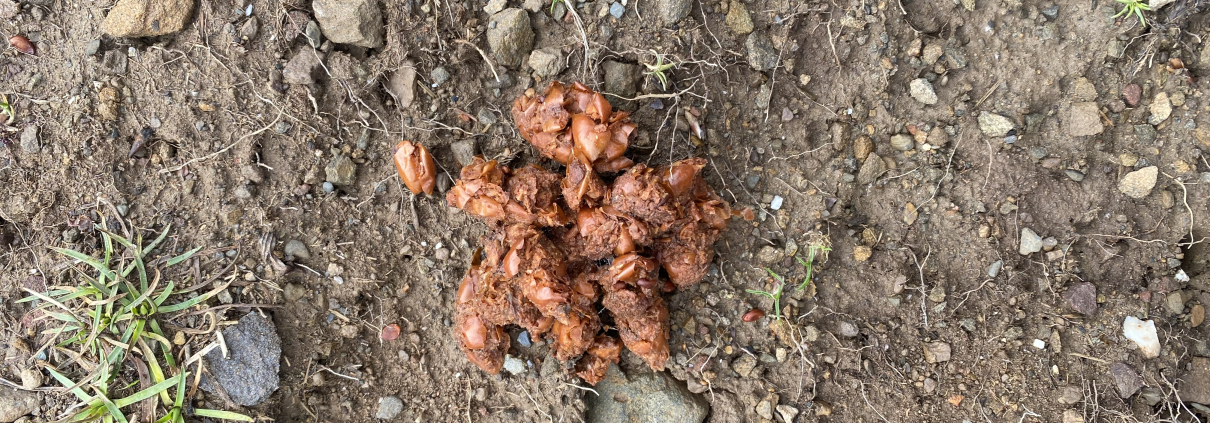
Out at Mailrock Farm, the land rises in quiet gestures, rocky outcrops breaking through the soil, Wandoo leaning into the sky. Their trunks are bumpy, full of life, textured with time and weather and everything that has passed through. There are signs of animals if you look closely, mostly scat, small traces that tell you this place is never empty. And, stark against the earth, the bleached curve of a sheep’s skull.
We are here together, Millennium Kids. Some of us have been part of this for years. Others are here for the first time, arriving with fresh questions. It shifts the energy. Keeps it alive.
Dr Simon Cherriman, The Re- Cyc-Ology Project, moves differently to the rest of us. Long limbed, deliberate, at ease. The tree seems to accept him as he climbs, rope and pulley in quiet conversation with gravity. A carabiner catches the light. Below, his son mirrors him in a smaller tree. His feet slip. For a moment he is suspended between holding on and letting go. Then he falls.
I catch him.
He climbs again, bolder now.
At the base of the small tree, there are signs of termites. A softening. A question of strength. I hesitate, then watch as learning continues anyway, in bodies as much as words.
Above us, clouds move in shifting tempos, slow, then sudden. A gentle wind threads through the canopy, rocking Simon high in the Wandoo branches. He calls down that the weather is good today. Any stronger, and he would not be up there.
We are installing hollows for Carnaby’s Cockatoos. They need to be placed within reach of memory, within a kilometre of known breeding sites. These birds live long lives. They learn landscapes slowly. There are breeding sites within twenty kilometres, so this is an offering. We may not see them here. Not yet.
But we will watch. 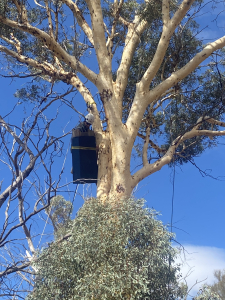
The hollow, more than twenty five kilograms, is lifted and secured with care, rubber hose wrapped gently so the tree is protected.
Simon speaks of thirty years of learning. Birds. Trees. Climbing, first with hands, then with ropes. How to raise something heavy into the canopy without harming what holds it. The tree is never just an anchor point.
Anna teaches through place. Through time. She speaks of her relationship with the farm, of partnerships that allow it to be run differently, more sustainably. We talk about diesel prices, about the reach of war, about how global forces land here in practical ways. Farmers carry a different scale of worry.
Around us, people watch, learn, try. Birds are spotted and named. Not always by me. I feel the edge of my own not knowing. Still, I look harder. I listen longer.
I know I am not holding all of it here. The day was fuller than this. Details are already slipping. But the feeling remains.
We are here to install boxes.
But that is not really why we are here.
Because birds are not beautiful just for their colours or their calls.
They are beautiful because they are wild.
Because they are free.
And because, for a moment, we are allowed to stand beneath them and know we will return.
Heather Johnstone, MK Mentor


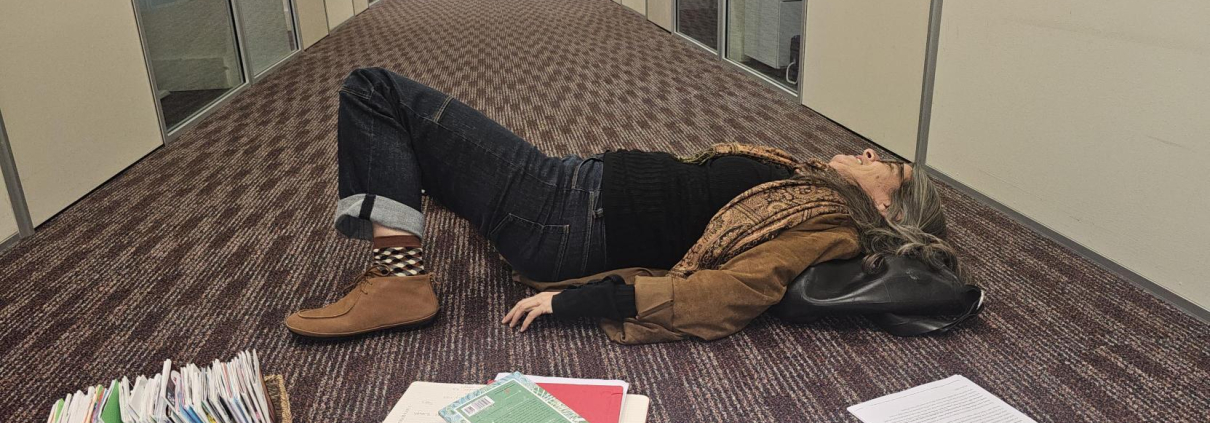
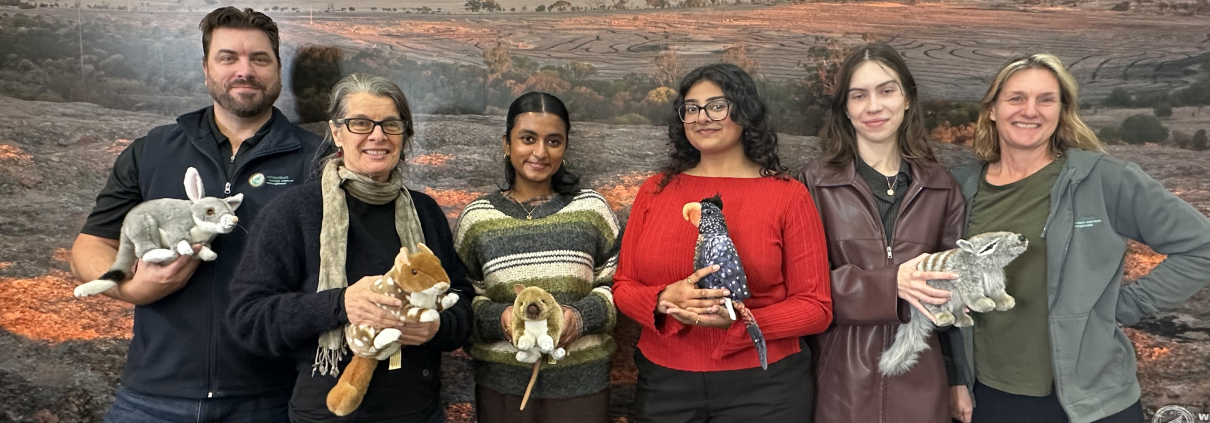
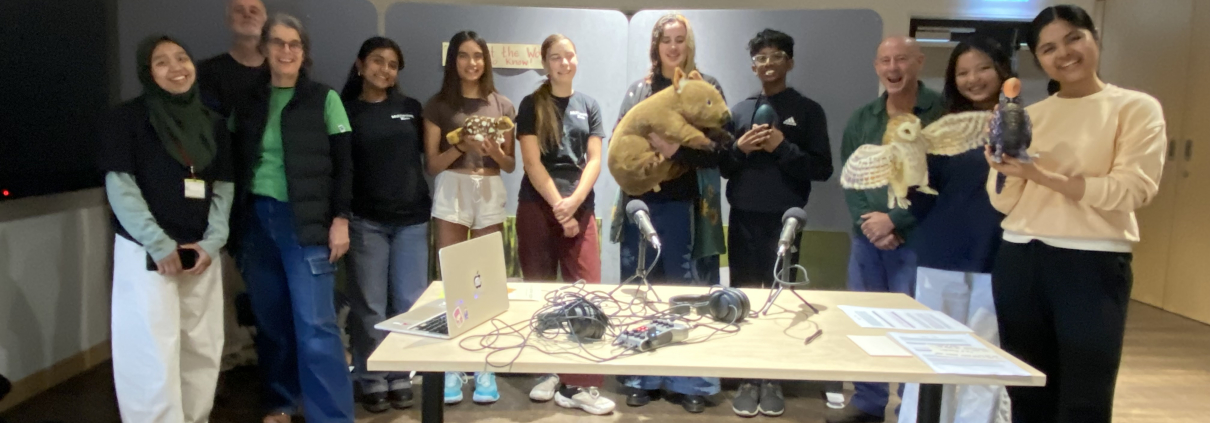



In theory, it’s easy given the right set of eagerness and talent, to engineer anything that obeys the laws of physics, to optimise the mechanisms that govern biology, and capture the beauty of the natural environment in an art form of any medium. However, social connection, a sense of community and genuine relationships sit in the adjacent fields in their level of difficulty to replicate. We can build better reticulation and energy storage systems, optimise the levels of ammonia in fertiliser to help our plants grow big and strong, but aside from the preferences of Tinder or the algorithms drawing you into the abyss on TikTok, you can’t manufacture social connection, a sense of community and genuine relationships from a blueprint.
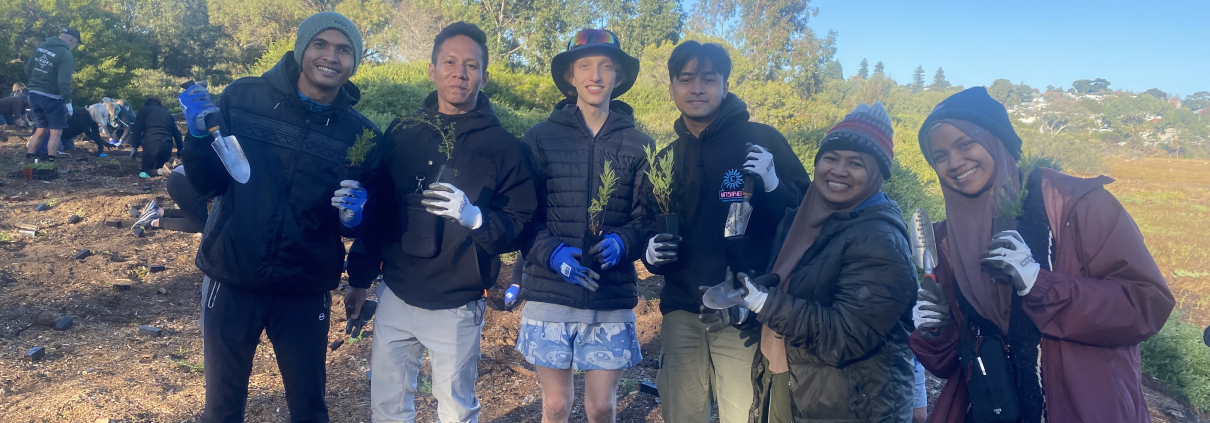
Enter FOLC. My first interaction was on a rainy Perth morning, where the Morten Bay Figs shaded the volunteers working below. I was greeted by smiling faces with a mission ahead. This selfless group of people where exactly what I was looking. For a while it was me hanging out with the ‘oldies’ at FOLC. That’s fine – nothing wrong with a cup of wisdom, a shot of experience, sprinkled with their endless kindness. After a few years dabbling in an assortment of projects – bandicoot bungalows, cockatoo hollows, alongside the usual planting, weeding and mulching I’d come to understand what we did, but not how we did it. How could I be a leader without the training and lifetime of experience that seemingly many others in the group had? And where were all the young people?
This is how the collaboration between MK and the FOLC began. MK is awesome because when you want to fly to the moon, they don’t tell you how expensive jet fuel is but give you a jetpack to make change.The goal of our collaboration is to increase youth engagement to ensure FOLC has a succession plan and doesn’t go out like the dinosaurs.
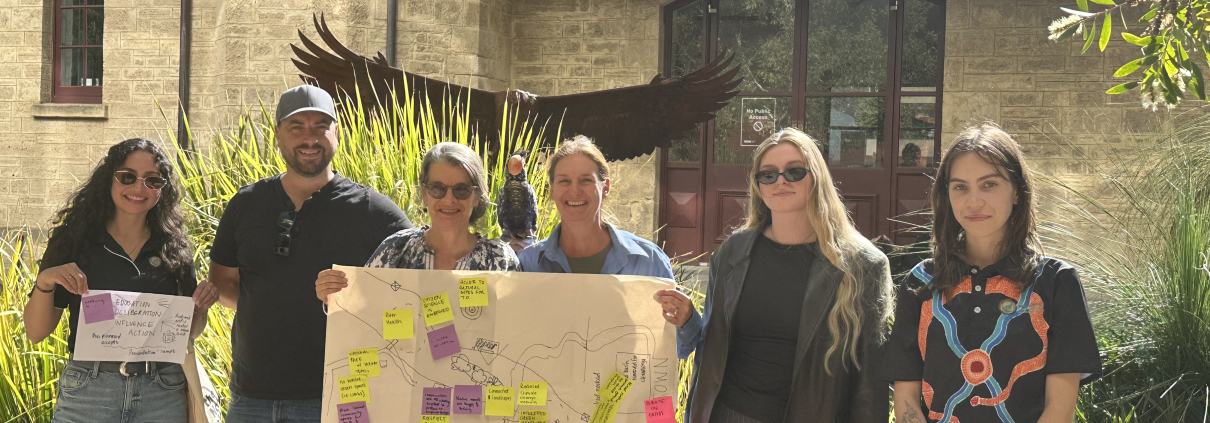
MK enables young people to take action on issues that they care about. Joining MK through their GreenLab program meant I’d take an unexpected non-linear trajectory. Alongside young leaders, we were exposed to action learning (do to learn, not learn to do) skills in risk management, governance, understanding liquidity for an organisation, and first aid.
And now with all these new skills I am working with the FOLC, MK and Town of Claremont to create a WA Tree Festival event, ‘Young Locals Nature Sundowner’ on Saturday the 16th of May 3-7PM at Lake Claremont. Through a nature walk and sundowner, with amazing paella, we’re crafting an experience which has the goal of attracting young people (18+) who want social connection, to meet their community, and to have a good time.
Check out the comments for a link to tickets.
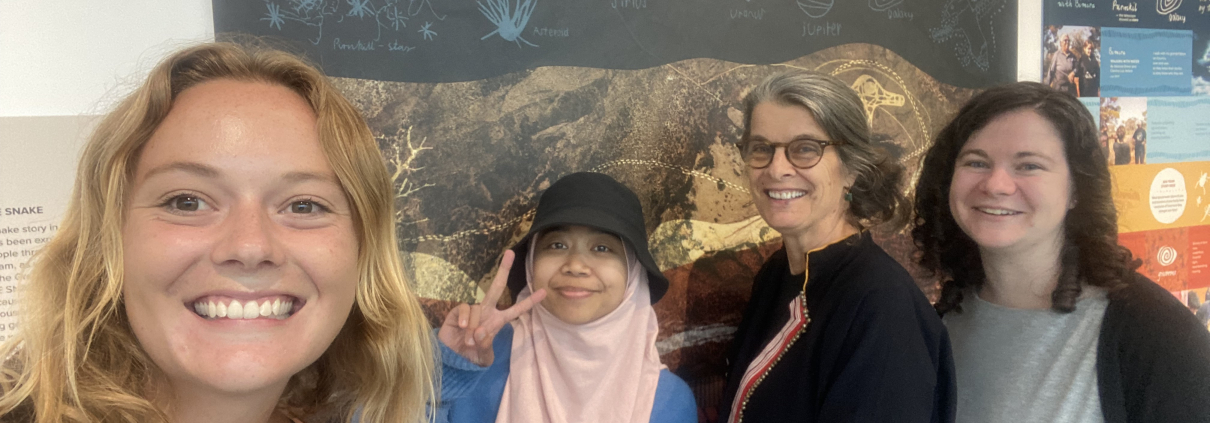
Photo: me sharing the FOLC love with our MK partners from Dompu.