

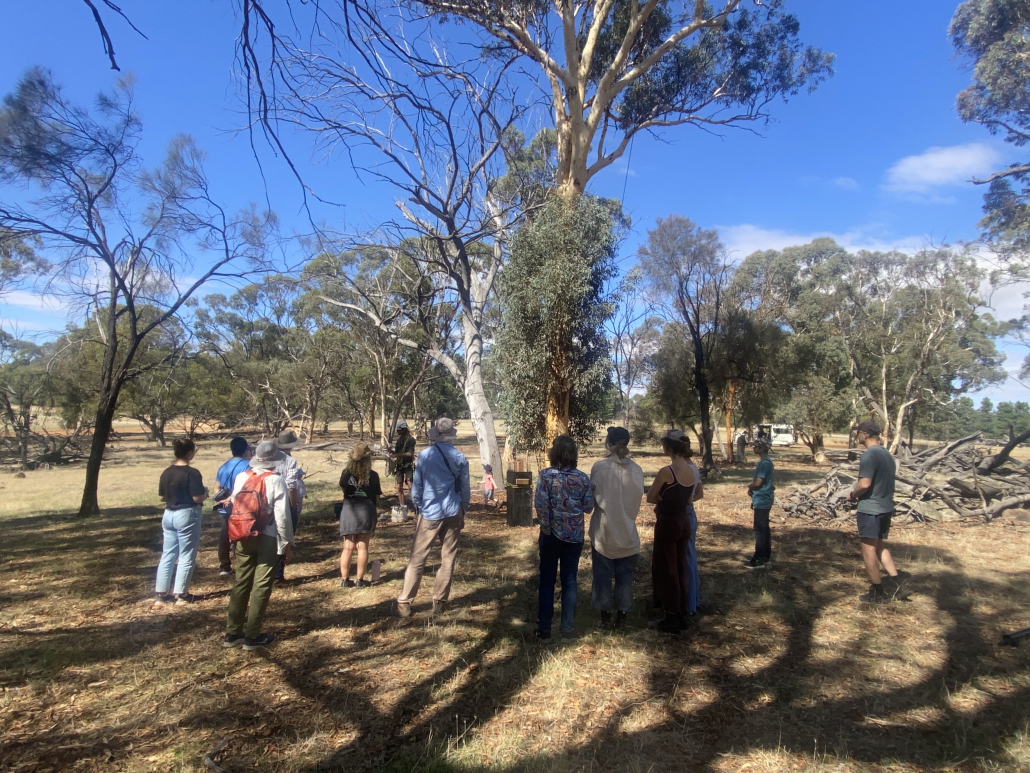
Out at Mailrock Farm, the land rises in quiet gestures, rocky outcrops breaking through the soil, Wandoo leaning into the sky. Their trunks are bumpy, full of life, textured with time and weather and everything that has passed through. There are signs of animals if you look closely, mostly scat, small traces that tell you this place is never empty. And, stark against the earth, the bleached curve of a sheep’s skull.
We are here together, Millennium Kids. Some of us have been part of this for years. Others are here for the first time, arriving with fresh questions. It shifts the energy. Keeps it alive.
Dr Simon Cherriman, The Re- Cyc-Ology Project, moves differently to the rest of us. Long limbed, deliberate, at ease. The tree seems to accept him as he climbs, rope and pulley in quiet conversation with gravity. A carabiner catches the light. Below, his son mirrors him in a smaller tree. His feet slip. For a moment he is suspended between holding on and letting go. Then he falls.
I catch him.
He climbs again, bolder now.
At the base of the small tree, there are signs of termites. A softening. A question of strength. I hesitate, then watch as learning continues anyway, in bodies as much as words.
Above us, clouds move in shifting tempos, slow, then sudden. A gentle wind threads through the canopy, rocking Simon high in the Wandoo branches. He calls down that the weather is good today. Any stronger, and he would not be up there.
We are installing hollows for Carnaby’s Cockatoos. They need to be placed within reach of memory, within a kilometre of known breeding sites. These birds live long lives. They learn landscapes slowly. There are breeding sites within twenty kilometres, so this is an offering. We may not see them here. Not yet.
But we will watch. 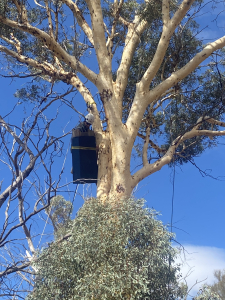
The hollow, more than twenty five kilograms, is lifted and secured with care, rubber hose wrapped gently so the tree is protected.
Simon speaks of thirty years of learning. Birds. Trees. Climbing, first with hands, then with ropes. How to raise something heavy into the canopy without harming what holds it. The tree is never just an anchor point.
Anna teaches through place. Through time. She speaks of her relationship with the farm, of partnerships that allow it to be run differently, more sustainably. We talk about diesel prices, about the reach of war, about how global forces land here in practical ways. Farmers carry a different scale of worry.
Around us, people watch, learn, try. Birds are spotted and named. Not always by me. I feel the edge of my own not knowing. Still, I look harder. I listen longer.
I know I am not holding all of it here. The day was fuller than this. Details are already slipping. But the feeling remains.
We are here to install boxes.
But that is not really why we are here.
Because birds are not beautiful just for their colours or their calls.
They are beautiful because they are wild.
Because they are free.
And because, for a moment, we are allowed to stand beneath them and know we will return.
Heather Johnstone, MK Mentor


